
Sources for Stanton Previous Residents
A house-history search needs a source that fits the era. The following coverage map separates title records from household records and shows where a gap must be handled offline. It is possible to use all five channels on one address, but each result should keep its original role. The previous residents of an address are reconstructed from dated clues, not copied from a single universal list.
| Source | Years covered | Where held | What it shows |
|---|---|---|---|
| Recorder index and copies | Web index since 1982; older books or fiche | Orange County Clerk-Recorder and Archives | Recorded parties, document dates, legal descriptions |
| Orange County reverse directories | 1955-1985, except 1961 | Library of Congress collection | Listed occupant or business by street and number |
| Orange County directories | 1926, 1929, 1931 | National Archives inventory | Stanton-listed directory snapshots around the 1930 census |
| Federal census | 1950 and earlier released schedules | NARA and library databases | Household snapshot and enumeration-district context |
| Stanton permits and planning | City record series, date range by request | City departments and City Clerk | Project participants, construction or alteration timeline |
| Newspapers, probate, and vital clues | Year and record dependent | Archives, libraries, courts, and custodians | Family, event, death, estate, and address connections |
Start with the date you want to explain. For 1982 forward, use the web index. For 1955 to 1985, search the reverse-directory run. For the 1930 period, pair the 1926, 1929, and 1931 NARA entries with the census. For earlier material, use county archives, newspapers, family records, and place-name variants.
Note: The year of a directory entry matters as much as the name because coverage is not continuous.
Step Back Through the Deed Chain
The strongest title path begins with a current APN and moves backward through grantor and grantee names. The Orange County Grantor/Grantee Index can identify a newer deed, deed of trust, release, lien, map, or other recorded document. It does not provide the full image online. Use the index to find the identifier, then order the copy from the Clerk-Recorder. For older years, use index books or fiche, the recorder counter, or Orange County Archives.
- Resolve the current address to an APN and preserve the situs, legal description, tract, lot, and unit wording.
- Search the newest title-affecting deed and record its grantee, grantor, recording date, document type, and instrument number.
- Search the seller as a prior grantee, narrowing by APN, date, and legal description when possible.
- Repeat backward, separating deeds from financing documents, releases, reconveyances, easements, and liens.
- When the online boundary ends, use the book/page or instrument reference to request the older copy.
- Grantor
- The party transferring, releasing, or giving an interest in a recorded instrument.
- Grantee
- The party receiving an interest or benefit described in the instrument.
- Chain of title
- The linked sequence of recorded interests used to trace a parcel through time.
- Legal description
- The tract, lot, block, or other formal parcel description that can match a property when a street label changes.
What the 1982 Boundary Changes
Orange County’s online recorder index covers documents recorded since 1982. That date is a web-search boundary, not the beginning of the county’s records. OC Archives preserved and digitized 640 original deed volumes dated 1889 to 1926 and conserved or converted 210 property-index volumes dated 1889 to 1953. The county has e-recorded since 1997 and passed 10 million electronically submitted documents in October 2021. Preservation does not mean every image is freely searchable online.
For a pre-1982 address, preserve any old book, page, instrument, map, tract, lot, or legal-description reference. Staff expressly will not conduct a broad recorder search by phone, in person, or mail, so discovery comes first. The official copy route lists $1 per page plus $1 certification per document or map. A self-addressed stamped envelope, check payable to County of Orange, and an identifier are needed for a mail request.
The Clerk-Recorder copy instructions describe the difference between finding an index entry and ordering the recorded pages.
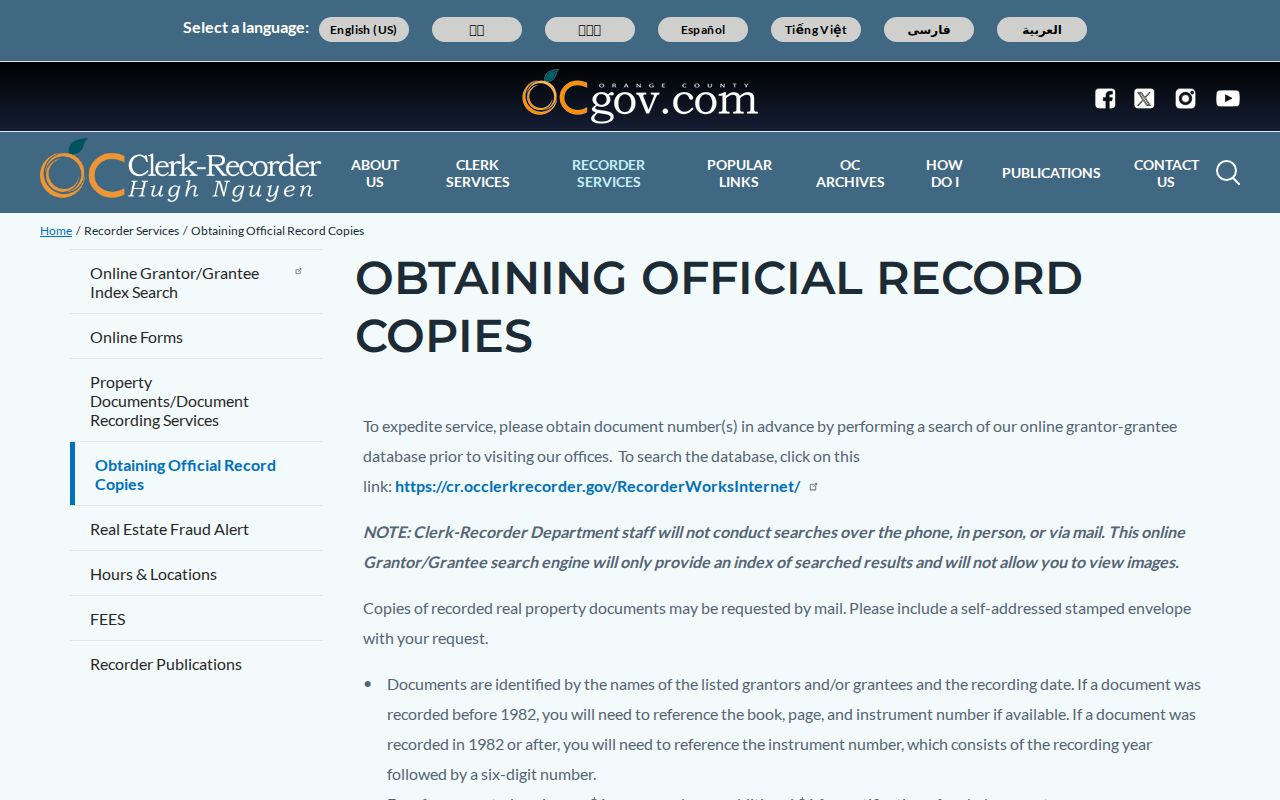
The copy instructions are the handoff from a directory lead to an official recorded document.
Reverse Directories Fill the Middle Years
The Library of Congress documents Orange County street-address directories for 1955 through 1985, except 1961. This run is a rare bridge between a modern deed chain and older census evidence. Start in the reverse section with the street name and number. Copy the listed occupant or business and the volume year. Then check the alphabetical section for a name-to-address cross-check, spouse clue, or occupation when that volume supplies one.
Use the word “listed” in your notes. Directory coverage can miss a year, spell a name differently, or capture a moment that does not last. Pair each result with an APN, a deed, a permit, a newspaper notice, or a later directory. The 1961 gap should remain visible in the timeline rather than being filled with an assumption.
The complete directory collection, including how to read an entry and where to find the volumes, belongs in the Stanton Directory Book. For an older address, those volumes serve as a backward trail rather than a current roster.
Note: The missing 1961 volume is a documented gap, not evidence that no household lived at the address.
Stanton Around the 1930 Census
National Archives inventory entries specifically name Stanton in Orange County directories for 1926, 1929, and 1931. The online inventory does not provide a verified publisher or open sample entry. Inspect the title page and locality heading before citing a volume. A 1930 census comparison should use the directory years as nearby snapshots, not as proof that a person stayed at one address throughout the interval.
NARA’s 1950 publication calls the place “Stanton (uninc.)” and reports 1,762 people. Enumeration-district maps and descriptions matter because a modern city filter can miss a 1950 household. Search the district, street, household members, and nearby community labels. Place names changed with civic status, so try Benedict, unincorporated Stanton, and Orange County alongside Stanton.
Pair Directories With Census Years
A directory lists people or businesses in a commercial or residential context. A census schedule captures a household at enumeration. They answer different questions and work best together. Use a date pair near the address history, then compare names, ages, relationships, occupations, street wording, and household members. When the records disagree, keep both observations and check a third source.
- Choose a directory year near the target event, such as 1929, 1931, or a reverse-directory year after 1955.
- Find the closest released census schedule and its enumeration district or map, rather than relying only on a present-day city filter.
- Compare the street, house number, surname, given names, spouse or relatives, and occupation.
- Check deeds, permits, newspapers, vital indexes, or probate for a date that explains a change.
- Record the exact source and uncertainty, especially where a directory year is missing or a name is common.
Permits Date Changes at an Address
Stanton building and planning files can explain when a parcel changed, even when they do not prove who lived there. The permit form separates Building or Grading, Commercial or Residential, and single-family, apartment, or condominium work. It can ask for the job address, permit number, owner or owner-builder choice, contractor license and class, project description, square footage, valuation, and signer role.
Request a closed permit or code record by job address, APN, permit number, and date range through the City Clerk or relevant department. The city’s enterprise catalog identifies CityTech Permits Pro and CityTech Code as address-keyed systems, but no public permit or code-case search was located. Applicants, contractors, owners, and signers must stay labeled. A construction record dates a project, not a resident.
Library and Archive Endpoints
OC Public Libraries’ Stanton branch is at 7850 Katella Avenue, Stanton, CA 90680, with 714-898-3302 and ocpl.stanton@occr.ocgov.com. Published hours are Monday through Thursday 10 a.m. to 7 p.m. and Saturday 9 a.m. to 5 p.m. Computers, Wi-Fi, staff help, licensed databases, and catalog referrals are practical research channels. The branch page does not promise a dedicated local-history or city-directory shelf.
Orange County Archives at 211 W. Santa Ana Boulevard, Santa Ana, holds county directories, historic newspapers and magazines, photographs, older property material, and other series. The Orange County Historical Society reports a reference library of more than 1,200 volumes and about 6,000 photographs. Its collection is community evidence, so pair a family or building claim with an underlying record. FamilySearch adds county marriage, birth, death, burial-permit, and Great Register material, with account or center restrictions on some images.
Newspapers, Probate, and Family Clues
The California Digital Newspaper Collection provides full-text historical newspaper searching, while OCPL Digital Newspapers and NewsBank add library-only or card-based channels. OCR can miss names. Try initials, spouse or relative names, address fragments, business names, and nearby community labels. Obituaries and legal notices can connect a person to a date, relative, estate, or former address, but they are not certified vital records.
For an heir trail, begin with death or marriage evidence, probate, and recorded transfers, then use directories and census schedules to place the household. Probate may name a decedent, petitioner, beneficiaries or heirs, counsel, and estate property, subject to access rules. A same-surname match is not proof of kinship. Keep the relationship as a hypothesis until the record supplies it.
Stanton Place Names Matter
The area was called Benedict before its civic identity settled. Stanton incorporated in 1911, disincorporated in 1924, and reincorporated on June 4, 1956. Orange County separated from Los Angeles County in 1889. These changes control how directories, census schedules, permits, and deed references are cataloged. A search that uses only the current city name can miss a useful earlier record.
Use the place name that fits the record’s year. Preserve older community wording in a search note, then connect it to the modern APN, street, or parcel map. The Pacific Electric Santa Ana-Watts line opened in 1906, and regional directories may therefore be more productive than looking for a self-contained pre-incorporation Stanton volume.
Note: Older place labels should stay in the research notes even after a modern parcel match is found.
House History Has a Lawful Boundary
House-history research is appropriate for family history, documented property history, genealogy, and personal curiosity. It should remain tied to dated public sources and the records’ stated access rules. California’s Safe at Home program supplies substitute mailing addresses for eligible protected people, and confidential court, voter, marriage, and vital records may not be exposed through a search shortcut. A public deed does not erase a safety protection, and an online index does not override a sealed record.
Verify identities with more than a name. A directory can show a listed occupant, a deed a recorded party, a permit an applicant, and a tax record a parcel. If a record is wrong, contact the custodian for correction or certified access. Do not use a previous-residents search to stalk, threaten, harass, or track a living person.
Use the trail for history. Preserve the address, date, APN, and source. Stop when the next step would defeat a confidentiality rule or create a safety risk.
Federal PACER can supply a federal docket lead for an Orange County matter, but it is a paid court system and not a substitute for county title or household records.
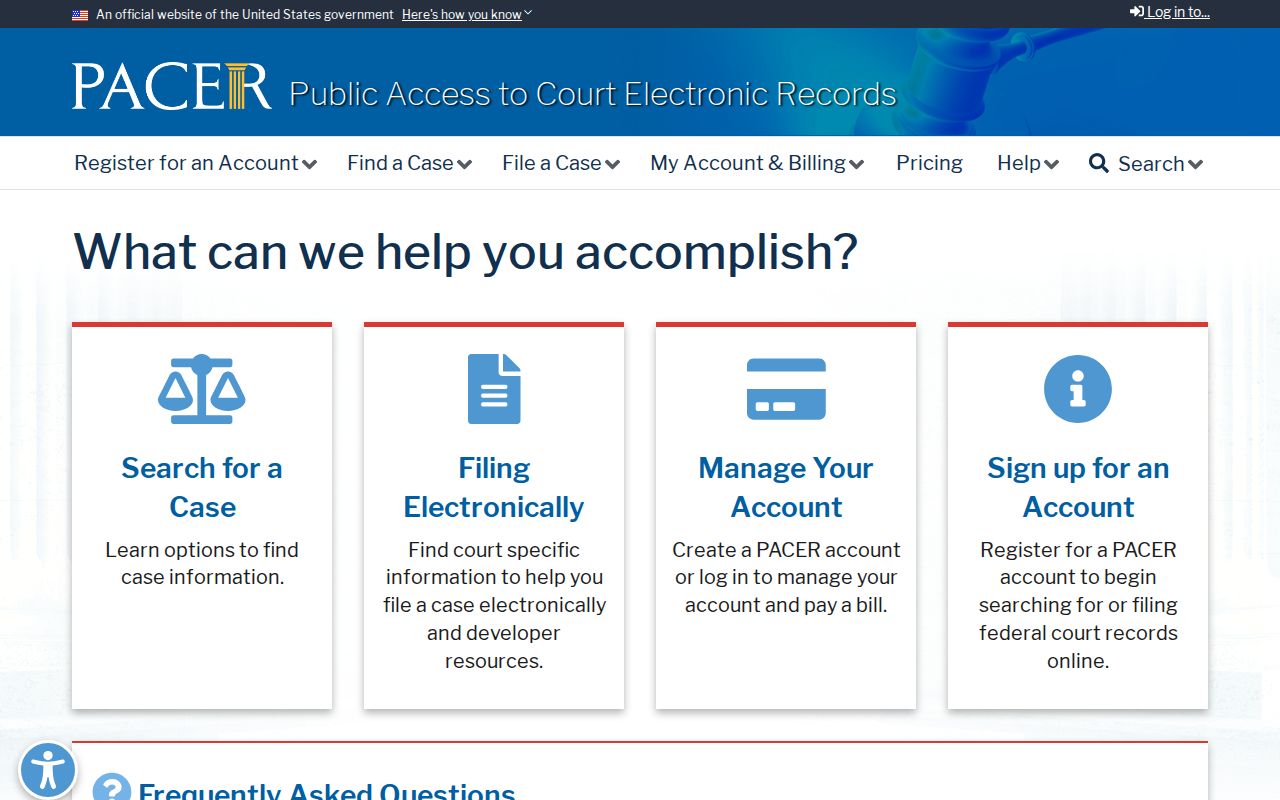
A federal docket is a case-history source. It should be kept separate from the parcel and directory evidence in a house-history file.