
Stanton Resident Lookup Coverage
A useful Stanton resident lookup assigns one question to one record set. A deed or tax parcel can connect a person or entity to recorded property interest, but it cannot prove who sleeps there now. A court index can expose a case party or a name variant, while a vital record confirms an event only under its copy rules. The table keeps those limits visible while showing the most direct Orange County and California starting points.
| Record | What It Confirms | Where | Access |
|---|---|---|---|
| Property and deed trail | APN, situs, recorded interest, mailing clues, and legal-description links | OC Tax Collector, Assessor, GIS, and Clerk-Recorder | Free address/APN tools; deed copies require an order |
| Superior Court records | Case parties, dates, case type, hearings, judgments, and name variants | Orange County Case Access, Court Index, and case-type portals | Online availability varies; name searches may carry a fee |
| Vital records | Birth, death, marriage, fetal-death, or dissolution events | OC Clerk-Recorder, local registrar, and CDPH Vital Records | Authorized or informational copies under statutory rules |
| Voter self-lookup | The requester’s own status, name, mailing address, party, history, and districts | Orange County Registrar of Voters self-service lookup | Identity-gated; voter files are restricted by approved purpose |
| Professional license | Credential type, status, issue and expiry dates, address of record, discipline links | California Department of Consumer Affairs search | Free search; boards use separate systems |
| Business entity filing | Entity status, agent, filed roles, addresses, and plain filing PDFs | California Secretary of State bizfile Online | Free search; filings vary and do not show every ownership detail |
| Unclaimed property | A possible holder or claim lead tied to a name, business, or property ID | California State Controller search | Free lead only, not residence proof |
Begin with the source closest to the known fact. A known address points toward an APN and recorded instrument. A family question points toward death, marriage, probate, and directory evidence. A credential question belongs with the licensing board. A search for another person’s voter address is not a valid use of the self-lookup, because that tool verifies the requester’s own record. Each result should be labeled as title, occupancy, event, role, or lead evidence rather than blended into one conclusion.
Verify One Stanton Resident
One-person research becomes safer when the name is normalized before any portal is opened. Write down current and former surnames, middle initials, suffixes, diacritics, business or trust names, and each spelling returned by a source. Then anchor the search with a known Stanton address, APN, ZIP, relative, date, case number, or life event. A look up a resident task should preserve contradictions instead of smoothing them away.
Use this sequence when a name needs confirmation across records:
- Define the question: title, historical occupancy, court matter, vital event, credential, business role, or custody lead.
- Normalize every name form and record the exact spelling, date range, and known Stanton geography.
- Run the narrowest matching source first, such as a case number, APN, license number, or event date.
- Compare at least two independent fields, such as a middle name, address, spouse or relative, date, or unique identifier.
- Retrieve the underlying document or ask the custodian for the proper copy when an index result matters.
- Log gaps and conflicts. A mailing address, permit applicant, directory occupant, or court alias has a distinct meaning.
The sequence matters because a common name can produce several plausible results. A directory resident may not own the parcel. A contractor may appear on a permit without being the occupant. A trust, limited-liability company, lender, or spouse may appear in a deed. The strongest match is a set of facts from separate custodians, with the record’s limits written beside it.
These terms keep the record trail precise:
- Docket
- The court’s running case record, including filings, hearings, actions, and outcomes listed for that matter.
- Index versus image
- An index is a finding aid with fields such as a name, date, and document number. An image is the recorded or filed document itself.
- Certified copy
- A copy issued or certified by the custodian as an official copy, subject to that office’s eligibility and fee rules.
- Informational copy
- A vital-record copy that may be available to an ineligible requester but is marked not valid to establish identity.
- Address of record
- The mailing or contact address filed with an agency. It is not automatically a home address or proof of current residence.
Stanton Court Lookup Results
Stanton matters go through the Superior Court of California, County of Orange. Civil, criminal and traffic, family, probate, and small-claims records use separate access paths. Orange County court holdings date to 1898, yet online coverage varies by case type, retention, and confidentiality. A missing web result can reflect a hardcopy-only file, a sealed matter, a spelling issue, or a record that is no longer retained.
The Orange County Court Index screen shows the county’s terms and name-search entry point. It is useful for locating a case number or party trail, but the index is not the same as a certified court file.
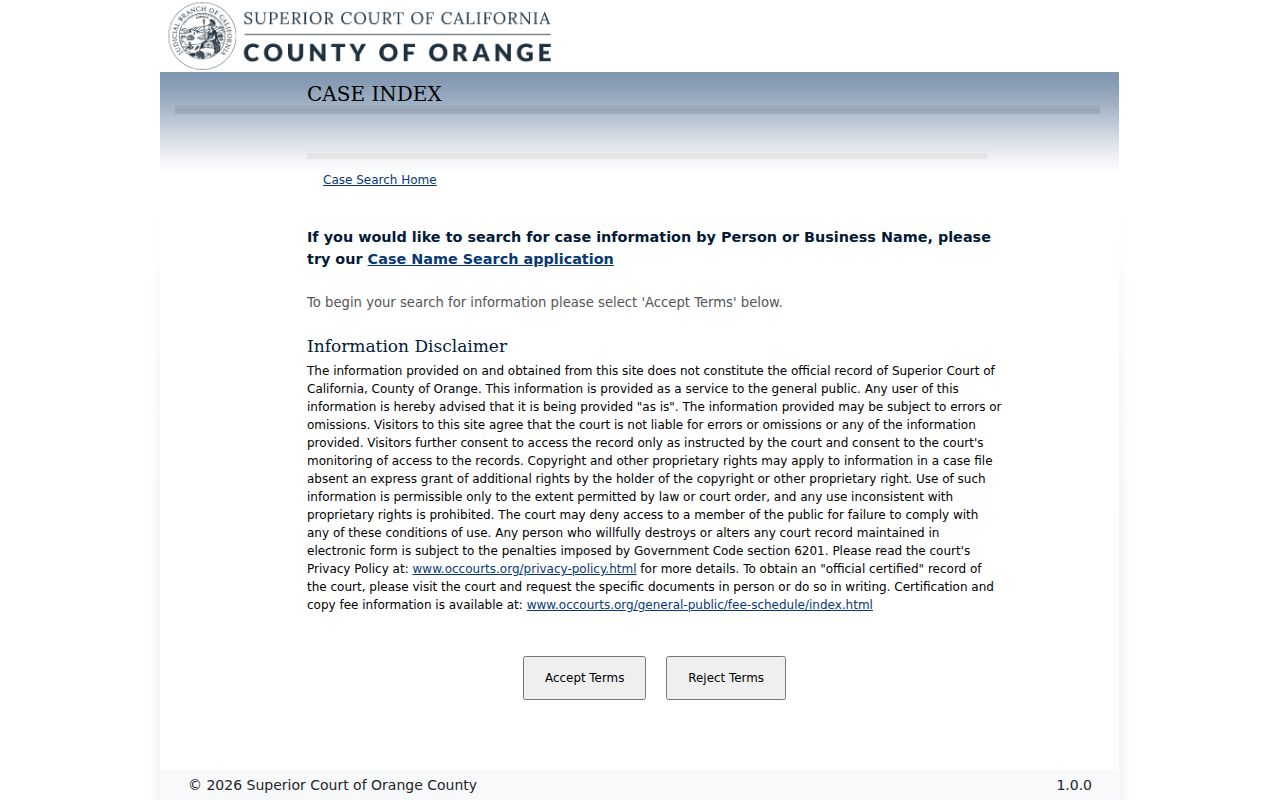
The returned spelling, case type, and case number should be copied exactly before moving to a clerk request or a more specific case portal. Name search may carry a fee, so a known case number is often the cleaner route.
| Field Label | Type | Required | Options / Format Notes |
|---|---|---|---|
| Case Name Search email | Text | Yes for login | Free enrollment is required; a registered user may search their own name free. |
| Password | Password | Yes | Login, enrollment, and password-recovery controls are provided. |
| Case Number | Text | Direct case-number mode | Use the full number; a partial number is not reliable. |
| Person or Business Name | Linked search mode | Conditional | Routes to the name-search application; a fee may apply. |
| Justice Center | Dropdown | Optional | Refines a calendar search by Central, Costa Mesa, Harbor, Lamoreaux, North, or West. |
| Courtroom | Dropdown | Optional | Further calendar refinement. |
| Prosecutor | Dropdown or text | Optional | Criminal calendar refinement. |
| Hearing Date | Date | Calendar search | More than 500 results requires narrower criteria. |
| reCAPTCHA | Challenge | Public criminal/traffic route | Helps prevent automated or bulk use. |
| Accept Terms / Search | Buttons | Not applicable | Electronic court information is not an official certified record. |
For a free case-number route, the Orange County criminal and traffic portal uses a CAPTCHA. A result may show the case number, defendant, aliases or other names, and demographics such as eye color, hair color, height, and weight.
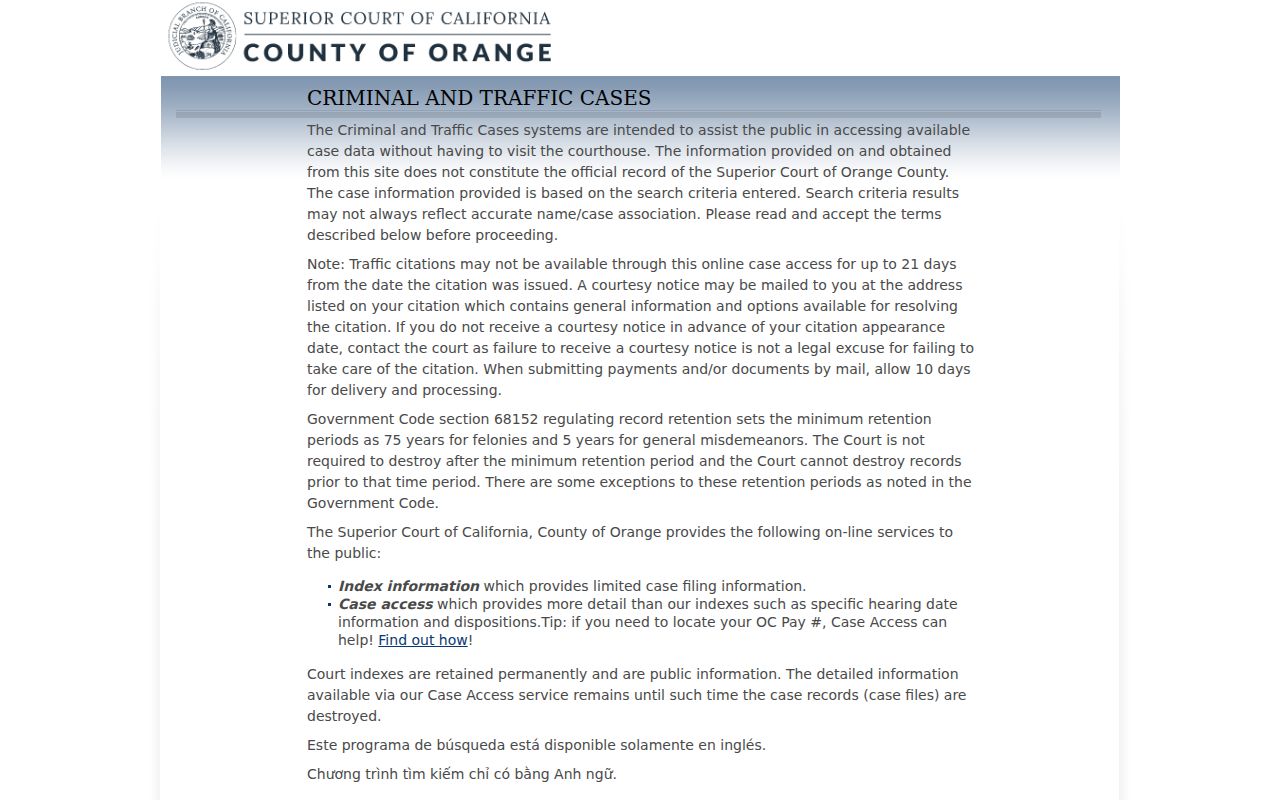
Broader case systems may show filing date and type, parties, register of actions, hearings, disposition or judgment, and links to documents allowed for remote viewing. Those fields help distinguish people with similar names, but they still do not replace a clerk-issued record.
The Orange County court records page shows the online, written, and counter routes for older or restricted material.
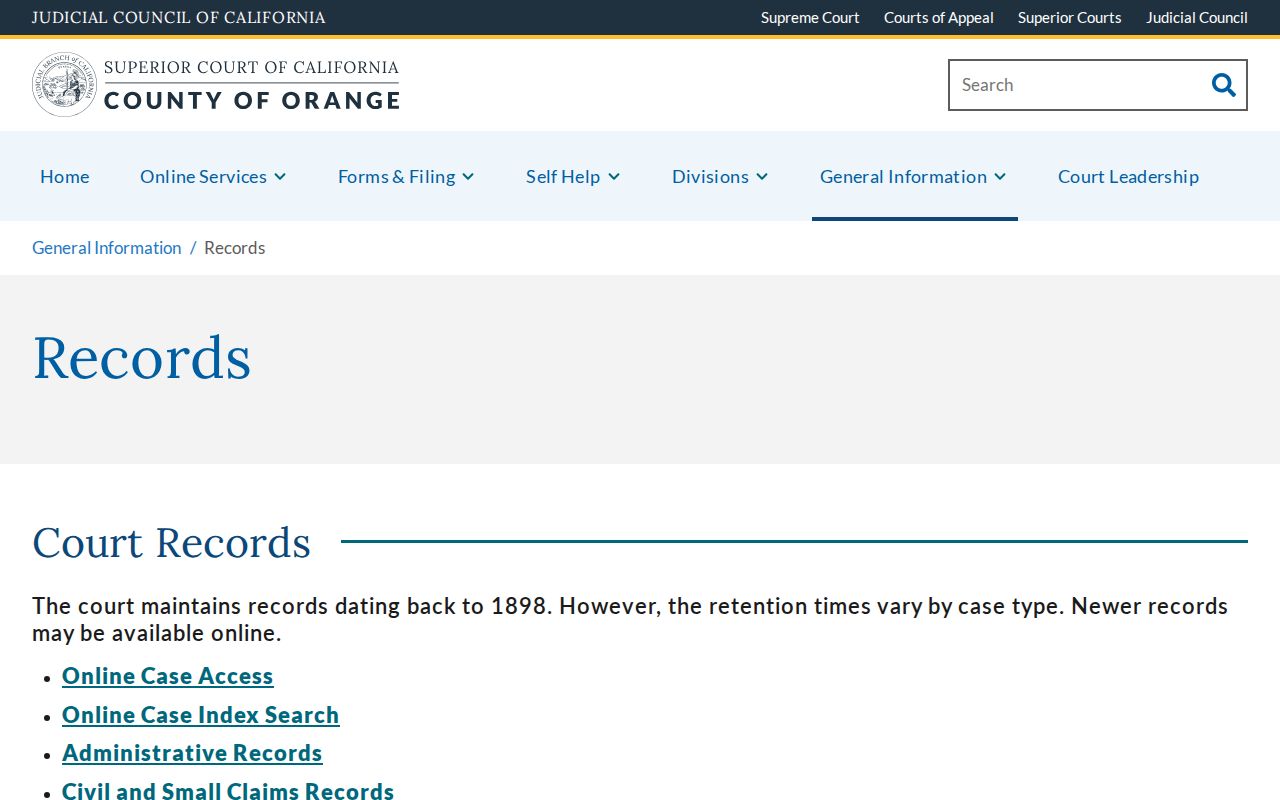
Rule 2.503 limits remote full-document access in family, juvenile, guardianship or conservatorship, mental-health, criminal, minor-compromise, harassment or violence, and elder-abuse matters. Sealed and confidential cases remain restricted. Rule 2.504 says an electronic court record is not official unless electronically certified.
For a written or counter request, form L-3009 asks for the requester, contact details, Justice Center, case or citation number, description, payment authorization, signature, and date. The listed charges are $15 per name search, $0.50 per page, $40 per certified document, $50 for exemplification, and $15 for a certified divorce decree, plus postage. Juvenile records are not available by mail. Confidential access requires party status with photo ID or a court order. Central Justice Center Records is at 700 Civic Center Drive West, Santa Ana, with 657-622-8736 and cjcrecordsmanagement@occourts.org.
Note: An online court result is a starting index entry; request a certified record when the source must carry official weight.
Stanton Vital Records and Copies
Vital records answer event questions, not every question about present residence. The Orange County Clerk-Recorder handles county birth, death, and marriage records, the Orange County Health Care Agency serves as local registrar for current or recent births and deaths, and the California Department of Public Health preserves statewide events since July 1905. A dissolution certificate from CDPH is different from the Superior Court decree.
| Record | Custodian path | 2026 fee | Access point |
|---|---|---|---|
| Birth | Local registrar for current or recent events, OC Recorder for county records, CDPH statewide | $31 | Authorized or informational copy |
| Death | Local registrar, OC Recorder, or CDPH depending on event and request | $26 | Authorized or informational copy; sensitive fields may be redacted |
| Public marriage | OC Recorder when licensed in Orange County, or CDPH statewide | $19 | Authorized or informational copy |
| Confidential marriage | OC County Clerk where issued | $19 where the state fee applies | Spouses or court order |
| Dissolution record | CDPH certificate or Orange County Superior Court decree | $18 for CDPH certificate | Court fees apply separately to a decree |
Authorized copies can establish identity only for eligible requesters. The eligibility list includes close relatives, a court-order recipient, certain attorneys or agents, qualifying government or law-enforcement requests, estate representatives, and other roles named in law. The application requires a notarized sworn statement and a declaration under penalty of perjury. An informational copy is marked “INFORMATIONAL, NOT A VALID DOCUMENT TO ESTABLISH IDENTITY” and may redact data. Health and Safety Code sections 103525 and 103526 and Family Code section 509 control the access framework.
CDPH mail applications use a check or money order payable to CDPH Vital Records. The fee is retained as a search fee when no record is found, and CDPH issues a Certificate of No Public Record. Published processing is four to six weeks; county issuance may be faster. CDPH does not email, fax, or digitally send certificates. Help is available at 916-445-2684 or VitalRecordsHelp@cdph.ca.gov, and mail goes to MS-5103, PO Box 997410, Sacramento, CA 95899-7410. For an older family trail, a vital event can be paired with the historical volumes described in the Stanton Directory Book.
Stanton Name Matching by Place
Human uses often require a trail rather than a single hit. An heir search can begin with a death or marriage record, move to probate and deeds, and then use directories or census evidence to test family connections. A former classmate or neighbor may surface first in a yearbook, newspaper, or reverse directory. A seller or scam check should compare a deed, entity, or license with an official custodian, not with details supplied in a solicitation.
Geography can separate two people who share a name. Stanton city limits intersect ZIP codes 90680, 92804, and 92841, while postal city labels do not always match municipal limits. Preserve the full street address, unit, APN, and legal description when available. For older records, test Benedict, unincorporated Stanton, Orange County, and nearby postal headings. Stanton incorporated in 1911, disincorporated in 1924, and reincorporated in 1956, so a catalog label can change even when a place is physically familiar.
The Orange County voter self-lookup is an identity-gated check for the requester’s own record.
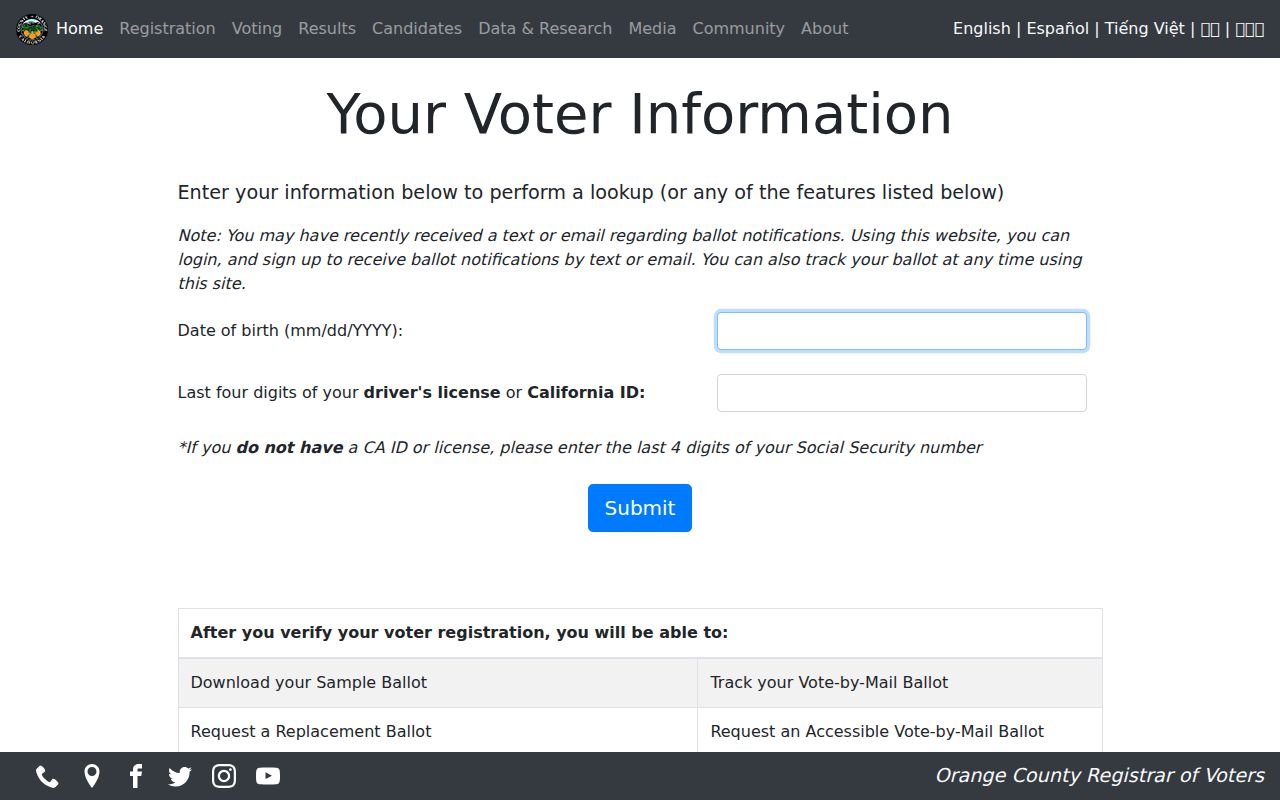
It asks for date of birth, the last four digits of a California driver license or ID or Social Security number, and the first three letters of the first name. Results can show status, name, mailing address, party, voter history, districts, ballot tracking, and guide options for the authenticated requester. Voter-file disclosure is restricted under Elections Code sections 2188, 2194, and 18109, so the form is not a public browser for a neighbor’s name or address.
Stanton Credential and Entity Checks
A license or business filing can verify a documented role without proving that a person lives at the related address. The California Department of Consumer Affairs search accepts board or bureau, license type or number, business name, first name, last name, and registry number. Results can show status, issue and expiration dates, address of record, and links to discipline. Separate boards may use their own systems.
The California Department of Consumer Affairs license search makes those fields visible before a name is tested.
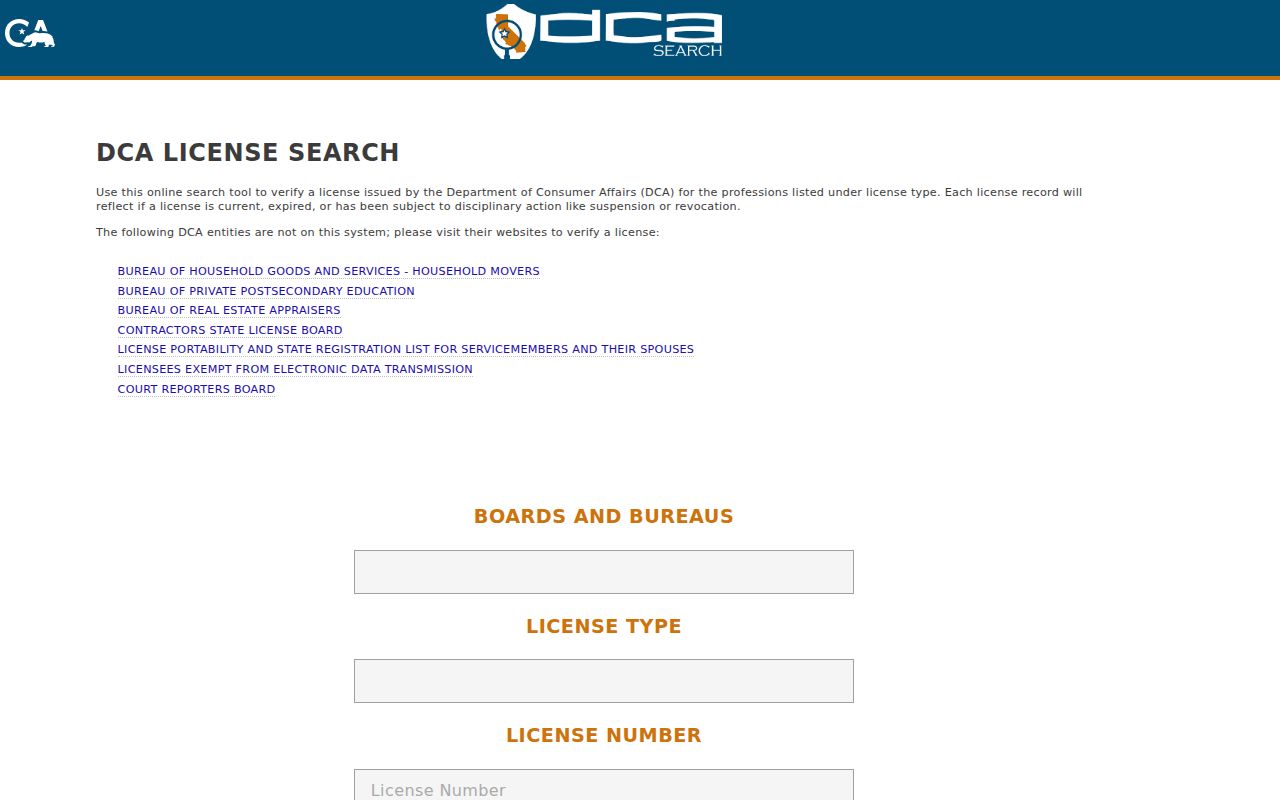
A present-name search can miss a former name. Match the license number, dates, board, and address of record, then open any public discipline detail. Keep a business address labeled as business evidence.
The Secretary of State’s bizfile Online business search accepts a name or file number, with advanced entity type, status, and initial-filing-date filters. Begins-with search can broaden a result, while ordinary closest-match output is capped at 500 results.
Newer 12-character entity IDs keep their beginning B. Filings may show an agent, officer, director, member, manager, status, jurisdiction, and street or mailing address. They do not establish beneficial ownership, phone, or email, and a filing role is not a residence finding. March 2026 request forms list $5 for a plain document, status, or no-record result.
For another narrow lead, the State Controller’s unclaimed-property search requires a last or business name or a property ID; first name and city are optional. Try an earlier surname or city when an heir trail suggests a change. A holder or claim result can lead to documentation, but it does not prove that a Stanton resident lived at an address.
Note: An address of record identifies a filing or license contact, not necessarily the Stanton resident connected with it.
Stanton No-Hit Search Fallbacks
A no-hit result is a prompt to inspect the search design. Test former surnames, initials, spacing, diacritics, business or trust names, a wider date range, and the legal party name rather than the street occupant. Check whether the portal requires a login or fee, limits a case category from remote view, begins only in a certain year, or accepts only the requester’s own identity. Retention, sealing, confidentiality, omission, and a change in civic or postal label can all interrupt a person search.
When the custodian is known but no portal answers the question, the California Public Records Act, Government Code sections 7920.000 and following, provides a request route for identifiable public records. An agency generally determines disclosability within 10 calendar days and may extend that determination by up to 14 days in unusual circumstances. Charges are generally limited to direct duplication costs. A Stanton City Clerk public-records request can target a city permit, agenda, contract, or administrative record by address, person or business name, and date range, but it does not replace the county custodian for deeds, court cases, or vital certificates. Ask for segregable nonexempt portions and the specific basis for any withholding.
The same rule applies to a correction. Preserve the exact search terms, portal, filters, and inspection date, then contact the office that created or maintains the record. Do not turn a portal’s absence into a claim that an event never happened.
Stanton Privacy and Safe at Home
Some residents are deliberately harder to locate. California’s Safe at Home program gives eligible survivors and protected persons a substitute mailing address. Certification is free, lasts four years, and can be renewed. A participant must report an address change within seven days, and mail forwarding can add two to three days. State and local agencies generally accept the substitute address, but private or federal organizations may not.
The California Safe at Home program does not erase a deed already recorded. Property acquired in a participant’s own name can still expose a legal description or property location at the assessor. Under Government Code section 6208.1(b)(1), a participant may make a written demand to remove online display of a home address or phone number, although the property legal description may remain.
A current privacy option is CalPrivacy DROP, the Attorney General’s free centralized tool for deletion or non-sale requests to more than 500 registered data brokers. A California resident confirms residency, creates an encrypted profile, and sends one request. The broker deletion duty began August 1, 2026. Use the government tool rather than paying an intermediary. A private opt-out does not delete a lawful court, deed, voter, or vital record held by its official custodian.
Note: A privacy request can limit online display while leaving a lawful government record or property description available.
Lawful Limits on a Resident Lookup
Use the lookup for a defined, lawful personal purpose such as family history, reconnecting with a relative, checking a recorded transaction, or confirming a public professional role. Do not stalk, threaten, harass, intimidate, or target a protected person. California’s Penal Code section 290.46(j) warns of criminal and civil consequences for misuse of registry information. Court, custody, and registry systems can contain errors or omissions, so a name, age, or address alone is not enough to identify someone.
Lawful personal use. Verify important facts with the office that holds the record, respect sealed and confidential material, and stop when a source does not authorize access. Using records to stalk, harass, or harm any person is prohibited.
When the goal changes from one person to everyone connected with an address, move to the current address-keyed records and parcel workflow in the Stanton Street Directory. For a single person, keep the source trail narrow, record the limits, and let the custodian’s copy or certification carry the final weight.